英語春節手抄報內容
從小學、初中、高中到大學乃至工作,許多人都接觸過一些比較經典的手抄報吧,借助手抄報可以有效培養我們的動手動腦能力。還苦于找不到好的手抄報?下面是小編精心整理的英語春節手抄報內容,僅供參考,歡迎大家閱讀。
英語春節手抄報內容
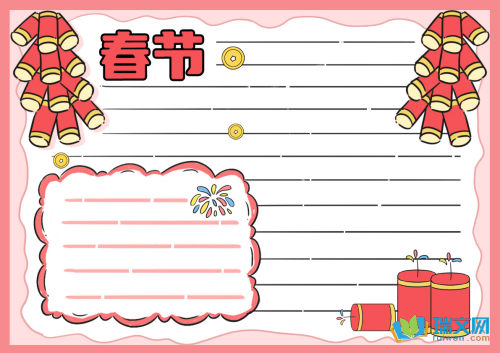
Festival name
The Spring Festival is also known as the Chinese Lunar New Year, commonly known as the New Year, New Year, New Years Day, etc. It is also known as the Chinese New Year or the Chinese New Year. The Spring Festival has a long history and evolved from the ancient times of praying for the new year at the beginning of the year and offering sacrifices. In ancient times, "year" was a tool for harvesting and offering sacrifices, and the character "year" represented the maturity of crops (the earliest writing of the word "year" was the image of a person carrying mature crops). People celebrate the harvest, offer sacrifices to the heavens and ancestors, and drive away ghosts and gods in various forms, gradually forming the custom of celebrating the Chinese New Year.
From an etymological perspective, the name "Spring Festival" consists of two parts: "Spring" and "Festival". "Spring" represents spring, symbolizing the beginning of a year, full of vitality, and the revival of all things. In traditional Chinese culture, spring is seen as a symbol of life and hope. "Festival" means a festival, which is a specific and significant day, and people will hold special celebration activities. Therefore, "Spring Festival" literally means a festival of spring, or a festival celebrating the arrival of spring. This also reflects the important position of the Spring Festival in the hearts of Chinese people. It is not only an ordinary holiday, but also a special moment symbolizing new life, hope, and reunion. As for the origin of the naming of the Spring Festival, as it marks the beginning of the Lunar New Year and coincides with the return of spring to the earth and the revival of all things, people named it "Spring Festival" to celebrate the arrival of a new year and the rebirth and renewal of nature. This naming also reflects the reverence and respect for time and nature in traditional Chinese culture.
Since ancient times, the first month of each year has been called January or January. Although the names are the same, the specific dates of the first month in different dynasties of ancient China were not the same. The Spring Festival was not a festival in Chinese history, but specifically referred to the "beginning of spring" in the 24 solar terms. During the Northern and Southern Dynasties, "Spring Festival" generally referred to the entire spring. The concept of "Spring Festival" was gradually introduced during the Republic of China period. After the Xinhai Revolution, the Gregorian calendar was adopted to record the year, and the first day of the lunar month was renamed "Spring Festival", while the first day of the Gregorian month was renamed "New Years Day".
The Origin of Festivals
The origin of ancient traditional festivals is related to ancient primitive beliefs, sacrificial culture, as well as human and natural cultural content such as astrology and calendar. According to the research results of modern anthropology and archaeology, the two most primitive beliefs of humans are: the belief in heaven and earth, and the belief in ancestors. Most ancient traditional festivals were formed by ancient people choosing a day for worship, to express gratitude to the gods, ancestors, and to pray for blessings and ward off evil. The origin and development of the New Years Day cover aspects such as humanistic philosophy and natural laws.
In the early era of observing and timing, "Dou Bing Hui Yin" was the beginning of spring (the beginning of the year), indicating that a new year had begun. The concept of "Sui" comes from ancient calendars, where "Sui" refers to "Sheti" (primitive stem and branch), also known as "Suixing" or "Taisui". In the process of inheritance and development, later generations simplified this set of multi syllabic era (year) terminology into a single character, which is recorded in comparison with the simplified Ganzhi in both Erya and Shiji, such as Taisui in Yin as Shetige, in Mao as Dane,... in Confucius as Jidun, in Chou as Chifenruo (from Erya · Shitian). The Ganzhi era begins with the month of Jianyin, which points due northeast from the handle of the Big Dipper, and then rotates clockwise in a circular motion. In traditional culture, the stem and branch are related to the direction and the eight trigrams. The Yin position is the Gen position of the acquired eight trigrams, which represents the intersection of the end of the year and the beginning of the year. It represents the end and beginning. For example, in the "Yi · Shuogua Zhuan": "Gen is the hexagram of the northeast, and the end and beginning of all things are formed." The twelfth month runs and repeats, with the end of the year and the twelfth month referring to the ugly side, and the first month returning to the Yin position. ". The handle returns to the Yin, the spring returns to the earth, and once again, everything is renewed, marking the beginning of the new year.
In traditional agricultural societies, the beginning of the Spring Festival, which returns to the earth, repeats itself, and updates everything, is of great significance and has given rise to a large number of related customs and traditions. Although the promotion of the Yin Yang combined calendar system in historical development resulted in different dates for the beginning of the year, its festival framework and many folk customs have been inherited. The Spring Festival evolved from the ritual of praying for blessings at the beginning of the year. In ancient times, at the beginning of the year when spring returns to the earth, and everything is renewed, people held sacrificial activities to pay tribute to the blessings of the gods and ancestors, ward off evil spirits and disasters, and pray for blessings and blessings. The origin and development of the Spring Festival is a process of gradual formation, subtle improvement, and popularization. The Spring Festival culture, as an important component of traditional Chinese culture, carries a vast and profound cultural heritage, as well as records the rich and colorful social and cultural content of ancient people.
Festival customs
special purchases for the Spring Festival
Chinas traditional Chinese New Year culture has a long and rich history, and a variety of Chinese New Year customs have emerged throughout the country, with distinct characteristics in the north and south. Although customs vary in different regions, preparing New Years goods and giving New Years gifts are almost a must-have throughout the country. The process of purchasing New Years goods, including food, clothing, wearing, using, pasting (New Years red), giving (New Years greetings) gifts, etc., is collectively referred to as "New Years goods", and the process of purchasing New Years goods is called "processing New Years goods". Selling New Years goods is an important activity for Chinese people during the Spring Festival.
Sweeping dust
n folk culture, there is a custom of sweeping the house on the eve of the New Year on the 24th day of the twelfth lunar month. The folk saying goes, "Sweep the house on the 24th day of the twelfth lunar month.". Commonly known as "Sweeping Dust Day". Sweeping dust is a year-end cleaning, where every household has to clean the environment, clean various utensils, dismantle and wash bedding and curtains, sweep the courtyard of Liulu, brush off dust and dirt, and dredge open channels and hidden ditches. Everywhere is filled with a joyful atmosphere of cleaning and welcoming the Chinese New Year with cleanliness. According to folk belief, because "dust" sounds like "Chen", sweeping the dust before the New Year has the meaning of "removing the old and replacing the new". The purpose of sweeping away dust is to sweep away all the misfortunes and misfortunes, in order to pray for a clear and auspicious year ahead.
New Years Eve dinner
New Years Eve dinner, also known as New Years dinner and reunion dinner, refers to the family dinner at the end of the year and New Years Eve. The New Years Eve dinner originated from the ancient year-end ritual, where gods and ancestors were worshipped and reunited for a meal. The New Years Eve dinner is the highlight of the New Years Eve, not only rich and colorful, but also very thoughtful. Before eating the Chinese New Year meal, pay homage to the gods and ancestors, and only serve after the worship ceremony is completed. Generally, there are chicken (meaning good luck), fish (meaning more than every year), oyster sauce (meaning good market), hair dish (meaning rich), Rolls of dried bean milk creams (meaning rich), lotus root (meaning smart), lettuce (meaning rich), sausage (meaning long), etc. on the table for luck. The Chinese New Years Eve dinner is a family reunion dinner, and it is the most sumptuous and important dinner at the end of the year.
【英語春節手抄報內容】相關文章:
英語春節手抄報的內容06-24
春節英語手抄報內容06-26
春節英語手抄報內容精選08-18
春節英語手抄報內容大全08-26
英語手抄報的內容06-19
英語手抄報內容05-15
歡度春節的英語手抄報內容01-04
英語版春節手抄報內容08-21
英語手抄報內容大全07-06
英語手抄報內容集錦10-21